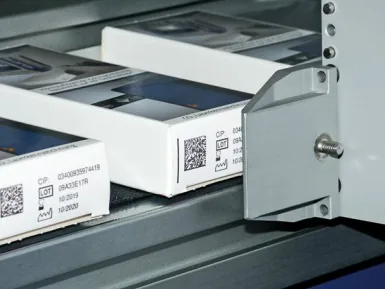
Inline versus offline packaging coding
Choose whether to print on the live packaging line or prepare flat cartons, sleeves, cards or pouches at a separate coding station.
Inline coding prints as part of the production line; offline coding separates flat packs or labels and marks them before they reach the packing process.
Inline coding is usually preferred when the code must follow live production data or be applied to a formed, filled or moving pack. Offline coding can be useful for flat cartons, sleeves, cards or pouches when batches are prepared in advance, the production line has no stable coding position, or several lines share one coding station.
| Decision | Inline coding | Offline coding | Pre-printed or coded label |
|---|---|---|---|
| Pack state | Formed, filled or moving through the packaging process. | Usually flat or separated before erection, filling or final packing. | Label is printed separately and applied later. |
| Data timing | Can be linked closely to the live product, batch, date or line job. | Data is assigned to a prepared batch of packaging components. | Data follows the label-production and application workflow. |
| Presentation | Depends on conveyor, web, product guides, trigger and line movement. | Depends on reliable feeding and separation of flat packs. | Depends on label print quality, reconciliation and applicator placement. |
| Changeover risk | Wrong job or physical setup can affect live product immediately. | Old and new stacks must be segregated and reconciled. | Obsolete labels must be controlled and removed from the line. |
| Best evidence | Line trial at real speed with starts, stops and verification. | Feed trial with the actual pack range and stack condition. | Label artwork, print verification and application checks on the finished pack. |
When inline coding is usually the stronger route
Inline coding keeps the print event close to the product and the production job, but it needs a stable physical and controls interface.
Live variable data
Choose an inline route where the message must change with the product, batch, time, serial number or upstream database. Define which system owns each field and what happens if the data connection is unavailable.
Formed or filled packs
Bottles, jars, tubs, cans and completed pouches may only expose the final code area after filling, closing or labelling. Check curvature, moisture, stability and downstream contact at the chosen position.
Integrated inspection and reject
Inline printing can be paired with product tracking, vision inspection, scanner checks and reject or product-hold logic. The whole sequence must be challenged with known good, bad and missing-code samples.
When offline coding can reduce line complexity
Offline coding is not simply “the same printer on a separate table”. The feeder must reliably separate and present each pack, and the prepared batch must remain controlled before it reaches production.
Flat cartons, sleeves and cards
A feeder can present flat folding cartons, sleeves, insert cards or suitable pouches to a printer before they are erected or filled. Send the full size range, board or film properties, stack condition and any folds, windows, embossing or static that could affect separation.
Shared or lower-volume coding
An offline station may support several packaging lines or short production runs without fitting a coder at every line. The operating procedure must identify the job, quantity, prepared-pack status and destination line.
Batch segregation
Control uncoded, correctly coded, rejected and surplus packs. Reconcile the prepared quantity and remove obsolete material at changeover so a clear print result is not undermined by a mix-up.
Offline inspection
Vision or scanner checks can be integrated with feeding, but the inspection must assess the actual required data and the system must define what happens to a failed pack.
Questions that decide the layout
Does the code depend on the live product?
If each code is tied to a live product record, serial number or production event, inline printing may simplify association. If a known batch of identical flat packs can be prepared and reconciled safely, offline coding may be credible.
Can the pack be fed consistently?
Flat packs must separate one at a time without doubles, slips or jams. Curled board, static, variable friction, windows, glue flaps, embossing and mixed stack conditions should be included in the sample trial.
Where is the most stable print surface?
Choose the route that gives the printer a repeatable distance, orientation and motion. A stable flat carton before erection may be easier than a curved or obstructed finished pack; a filled pack may be necessary when the code must follow live data.
How will changeovers be reconciled?
Define how old messages, part-used stacks, prepared packs, labels and rejected items are cleared. The procedure should leave no uncertainty about which packaging component belongs to the released job.
Information for an inline or offline quotation
- Flat and finished pack samples, complete size range and expected material variants.
- Required code, quantity per job, change frequency and source of variable data.
- Existing line video, normal and maximum output, available footprint and utilities.
- Feeding, detection, encoder, inspection, reject and product-tracking requirements.
- Required operator records, quantity reconciliation and acceptance test.
Compare both routes with real packs
Send flat and finished samples, the full message and line details so Lancing can assess whether printing should take place before or during production.
Test a cancelled or changed print job before choosing the workflow
An inline-versus-offline decision becomes clearer when you test a job that changes after preparation. Suppose cartons have already been coded but the production order is cancelled, split or moved to another day. Agree how those cartons are identified, segregated and either reused under an approved rule or removed from the available stock. The correct choice depends on how often this happens and whether the printed fields remain valid.
For an inline route, challenge a change of order while packs remain between the printer and inspection point. Confirm which job each pack belongs to, how the last old-job pack and first new-job pack are checked, and what happens to uncertain material. For an offline route, include part-used stacks, rejected packs and surplus coded stock in the same exercise.
If a barcode contains batch, date or serial data, assess both the encoded content and the physical print. A reader accepting the symbol does not prove that the code belongs to the current product. Ask for a recorded demonstration using your message fields and actual pack handling; it should show a controlled reconciliation process as well as a readable sample.
Can unused coded cartons be carried into the next job?
Only where the printed data remains valid and the approved reconciliation procedure permits their use.
Does a successful barcode scan confirm the right batch?
No. Readability and correct association with the released production order must be checked separately.