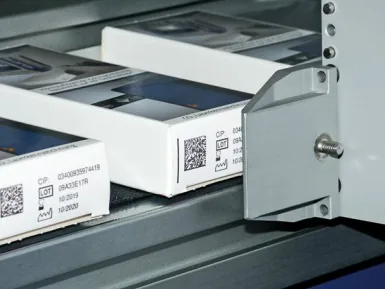
Carton coding machines for date and batch printing
Print readable dates, lot numbers, barcodes and QR codes onto cartons as part of an automated packaging process.
Application guidance for carton coding uk.
How to specify this coding application
Cartons are often a good fit for thermal inkjet coding because they can present a controlled, flat area for high-resolution printing. The specification should check carton material, conveyor stability, print height, line speed, message length and whether barcodes or QR codes need to scan reliably after handling.
- Carton face control and print-head distance
- Date, batch, barcode, QR and logo printing
- Ink selection for coated or uncoated board
- Line speed and trigger setup
- Message templates for multiple carton SKUs
- Rejected pack and quality-check considerations
Recommended coding routes
Use these routes as a starting point before confirming samples, speed, substrate and integration details.
Thermal inkjet cartons
A compact TIJ print-head can print variable data onto cartons when the surface and distance are controlled.
Labelled cartons
Coding may happen on a label before application if the carton face is unsuitable for direct print.
Traceability codes
QR and barcode carton coding should be tested for contrast, size and scanning after transport.
Related coding machinery pages
These pages help connect the application to the most suitable coding technology and support route.
Carton coding UK FAQs
What printer is used for carton coding?
Thermal inkjet is often used for carton coding where the carton presents a suitable printable surface.
Can a carton coder print barcodes?
Yes, thermal inkjet systems can print barcodes and QR codes, but scan quality should be validated on the actual carton.
Can cartons be coded on a conveyor?
Yes, provided pack spacing, speed, trigger sensing and print-head position are controlled.
What affects inkjet print on cartons?
Carton coating, dust, surface colour, speed, print distance and ink type all affect print quality.
Need help with carton coding uk?
Send your material, speed, code size and example data so Lancing can recommend the right coding route.
Separate folding-carton coding from outer-case marking
A retail carton and a corrugated shipping case can carry different data, move on different equipment and require different print or label technologies. Define which packaging level the code controls before selecting the machine.
Outer cases and shipping cartons
Direct case printing, logistics labels, GS1 data, conveyor tracking and downstream scanning.
Direct print or label
Compare information area, surface, background, adhesive, changeover, consumables and verification.
GS1 barcode and 2D data
Confirm the required symbol, identifiers, attributes, artwork, placement and receiving-system readiness.
Inspect and contain failures
Choose presence, content, decode or verification checks and prove tracking to reject or hold.
Provide flat and erected carton samples
Include the full message, code position, line path, customer barcode requirement and finished-pack handling.
Choose whether to code the carton flat or on the line
Folding cartons and sleeves can be marked before erection at an offline feeding station or coded inline after product loading, closing or labelling. The strongest route is the one that controls data, pack presentation, quantity reconciliation and inspection with the least ambiguity.
| Route | Main advantage | Main control point |
|---|---|---|
| Offline flat-carton coding | Provides a flat, accessible surface before the carton enters production. | Prove single feeding, stack condition, doubles control, code position and batch reconciliation. |
| Inline direct coding | Keeps the code close to the live product and production job. | Control product guidance, trigger timing, speed, print distance and line clearance. |
| Coded or print-and-apply label | Can provide a defined printable surface and larger information area. | Control label stock, variable data, verification, application position and obsolete labels. |
Samples for a carton-feeding trial
Provide the minimum and maximum flat carton or sleeve, board and coating variants, glue flaps, windows, embossing, folds and representative stack condition. Include the erected pack so the final code position can also be checked.
Compare inline and offline carton coding in detail and check whether the carton surface behaves as porous or coated stock.